Work

What holding a district
actually involves.

Dossier

Responsibilities, method and record — described without embellishment.


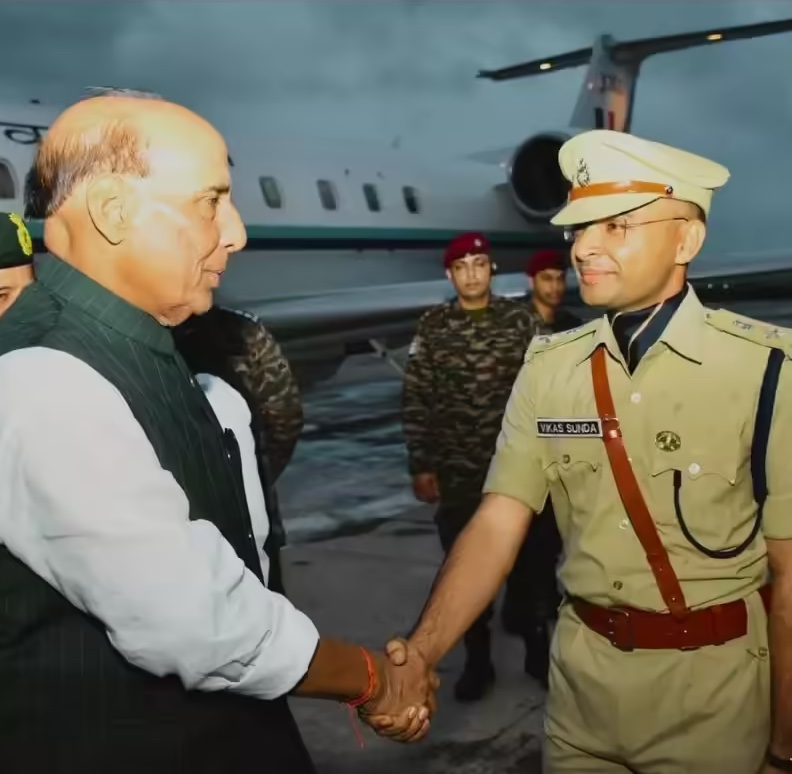
Vikas Sunda in service uniform shaking hands with a senior union dignitary on an airfield apron, with an aircraft and security personnel behind.
Receiving a visiting dignitary on the apron. In a border district, protocol duty and security duty are the same duty.
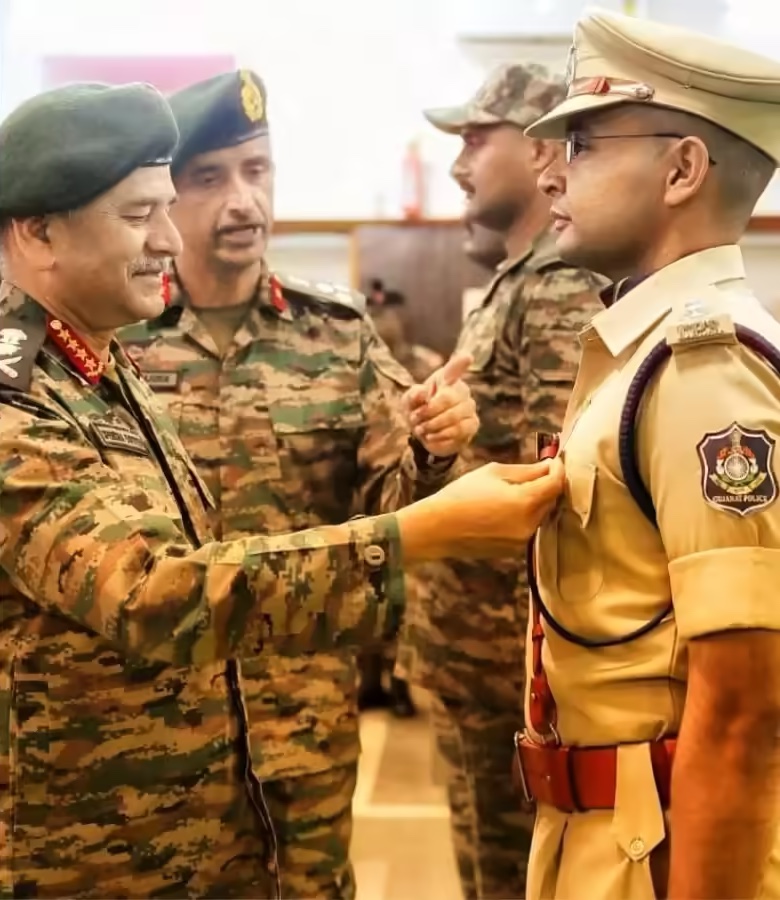
A senior Indian Army officer pinning a commendation on Vikas Sunda's uniform, with other officers looking on.
The Chief of Army Staff commendation, conferred on Independence Day 2025 for exemplary service during Operation Sindoor.

01  Professional focus

The primary responsibility is district command: the direction of the police organisation of Kutch (West), including its stations, its investigation, its public order function and its readiness posture. District command is unusual among senior appointments in that it is simultaneously strategic and immediate — the same officer who sets the year's priorities may be required, that night, to decide the disposition of a response.

Alongside it sits a second focus carried forward from earlier assignments: the security of a long and populated coastline, and the specific problem of building security arrangements that depend on civilian cooperation rather than on exclusion.

02  Areas of work

The functions below are the standing responsibilities of the office as it is exercised in a district of this character.

  • Public order. Assemblies, processions, festivals and seasonal gatherings — planned for in advance, policed with the lightest arrangement that will hold.
  • Crime and investigation. Registration, quality of investigation, and the supervision that determines whether a case survives contact with a court.
  • Border-district readiness. Standing arrangements with the armed forces and central agencies, kept current rather than revived when needed.
  • Coastal and maritime interface. Craft registration, harbour and landing-site liaison, and cooperation with the Coast Guard and the Navy.
  • Protocol and VIP security. The movement and safety of constitutional and ministerial visitors, executed without disruption to ordinary policing.
  • Traffic and road safety. On long-distance corridors where a delayed response is measured in hours, not minutes.
  • Force welfare and training. Rosters, rest, equipment and instruction — the least visible determinant of how a force performs under load.
  • Community interface. Access to the Superintendent's office, grievance redress, and the visible availability that makes reporting a crime plausible.

03  Approach

Three working commitments describe the method more usefully than any statement of philosophy.

Prepare in the quiet period. Coordination that has not been exercised does not exist. Contact lists, joint drills, radio discipline and mutual-aid understandings are established while nothing is happening, on the assumption that they will be needed exactly when there is no time to build them.

Treat the ordinary case as the standard. A district is judged by the public on its handling of the unremarkable complaint, not on its handling of the emergency. If the routine case is taken seriously, the emergency arrives in a force that already has the habits it needs.

Leave the system better documented than you found it. A tenure ends. What should survive it is written procedure, trained personnel and functioning relationships — not a reputation for personal indispensability.

04  Selected contributions

Recorded below are appointments and recognitions that appear in official listings or official public announcements.

Charge

Superintendent of Police, Kutch (West), Bhuj

District command from December 2024. Listed in the official district administration record.

State

Superintendent of Police, Coastal Security, Gandhinagar

State-level responsibility for the coastal security establishment, from 2022.

Protocol

Aide-de-Camp to the Governor of Gujarat

Raj Bhavan, Gandhinagar. Recorded in the state IPS civil list of February 2023.

Award

Chief of Army Staff Commendation

Independence Day 2025, for exemplary service during Operation Sindoor. Announced by the Director General of Police, Gujarat.

05  Experience

The value of the sequence is that it covers the three distances at which a police officer works. Sub-divisional charge in Bharuch is policing at arm's length from the citizen — the officer is reachable, and is held to account face to face. Coastal security at Gandhinagar is policing at the level of a system, where the unit of work is an arrangement rather than an incident. Raj Bhavan is policing at the formal distance of constitutional office, where the requirement is precision rather than discretion.

District command in Kutch (West) requires all three in the same week. The Superintendent who is unreachable loses the district; the one who cannot design a system is overwhelmed by it; the one who cannot execute a protocol movement cleanly creates a problem where none existed.

06  Perspective on work

Policing is one of the few public functions whose success is invisible by construction. A prevented incident produces no record, no photograph and no statistic. This creates a permanent temptation to pursue the measurable at the expense of the important.

The defensible position is to accept the asymmetry. Do the unglamorous, unrecorded work — the drill that is never used, the relationship that is never called upon, the complaint resolved before it became a case — and accept that most of it will never appear in an assessment. The alternative is a force optimised for the appearance of activity, which is a different institution wearing the same uniform.

The principles behind it